
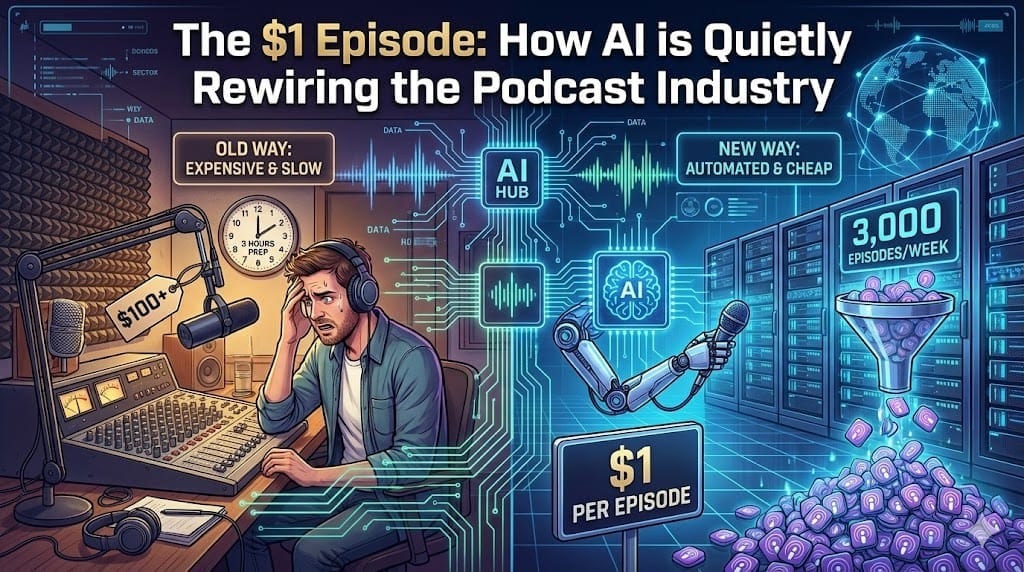
The digital airwaves are no longer just crowded; they are experiencing an industrial content coup. While human creators agonize over sound treatment and guest booking, AI is flooding the zone with thousands of episodes for the price of a small latte. We are witnessing the transition from a craft-based medium to a high-frequency, automated marketplace where the "cost of entry" has been replaced by the "cost of noise."
The End of the "Expensive" Podcast
The economic foundation of audio is undergoing a cost-floor collapse that favors asymmetric competition over traditional production. Inception Point AI, operating through its "Quiet Please" network, is the vanguard of this shift, churning out 3,000 episodes per week with a skeleton crew of just eight employees. By driving production costs down to a staggering $1 per episode, they have shattered the traditional media model.
Analyst's View: This represents the "death of the middle." When a show becomes profitable at just 20 listeners, the need for mass-market appeal evaporates, enabling hyper-niche content—like city-specific pollen count updates—that was previously a fiscal impossibility.
"Listeners ultimately seek connection with human consciousness, something AI can't replicate," warns industry veteran Marshall Poe, highlighting the tension between this automated expansion and the medium’s soulful roots.
The "Trust Gap" and the Illusion of Detection
For brands and creators, the "trust gap" has become a vital metric of market survival. Data shows that listeners experience a 27% drop in trust the moment they believe they are hearing an AI, and human voices consistently trigger 24% more brand attraction. However, the listener's confidence is largely a delusion; while 60% of participants claim they can confidently distinguish human from synthetic voices, their actual detection accuracy sits at 50%—the statistical equivalent of a coin flip.
Analyst's View: We are entering an era where perception is more impactful than reality. Creators aren't just fighting for better audio quality; they are fighting the psychological bias against "synthetic" delivery, even when the listener cannot actually tell the difference.
The Demographic Shift to Gen Z and Global Markets
The growth trajectory of the audio market is tilting decisively toward younger cohorts and emerging economies. Gen Z adoption is projected to reach 69% by 2028, signaling a move toward shorter, video-integrated formats often discovered via social platforms. Simultaneously, the Asia Pacific region is leading the world with a 29% CAGR, fueled by smartphone penetration and a hunger for localized content.
Analyst's View: AI’s multilingual capabilities are the secret weapon for global capture. The ability to instantly re-voice and translate content into dozens of languages allows platforms to unlock massive, untapped audiences in regions where native-language content was historically scarce.
The "Napster Moment" for Audio IP
The industry is currently facing a predatory economic phase that mirrors the early days of music piracy. High-volume producers are utilizing "content appropriation" to train systems on millions of hours of existing human work, leading Marshall Poe to describe the market as "beyond glutted." This "podcast slop" relies on an unofficial business model where the theft of IP is an accepted strategy for well-funded firms.
Analyst's View: This is a classic "free-rider" problem. Technology firms are harvesting the accumulated knowledge and creative labor of a decade of human podcasting to power automated systems that ultimately threaten to starve those same independent creators of visibility.
The Rise of the "Hybrid" Creator
Despite the rise of the machines, the near-term future belongs to the "hybrid" model rather than pure automation. Currently, 40% of podcasters are already integrating tools like NotebookLM and ElevenLabs into their workflows to slash operational costs by up to 50%. These creators use AI for the "heavy lifting" of transcription and research while maintaining a human host for emotional resonance.
Analyst's View: The winners in this landscape will be those who apply a "craft layer" to AI efficiency. Pure AI content mills will dominate the commodity information market, but creators who use AI to augment—not replace—the human element will command the premium advertising rates.
Conclusion: The Future of the Human Voice
The AI podcasting sector is a juggernaut, on track to become a $26.6 billion market by 2033. However, this growth has triggered a "Discovery Crisis" of epic proportions; with one company alone projected to produce 150,000 episodes in 2025, even the most advanced algorithms are struggling to filter quality from the flood.
We are fast approaching a fundamental crossroads in media consumption. As synthetic speech becomes indistinguishable from the real thing, the market will force a choice: Do we value the lightning-fast efficiency of the "what," or do we still crave the parasocial, human intimacy of the "who"?

Member discussion: